
How Much Does a Coffee Shop Make? Day, Month, Year

How much does a coffee shop make per day, month and year? Toast's figures, the math from your own POS data, what owners keep, and next month's revenue.

Black-and-white photo of Jamie Rosenberg smiling on a New York rooftop

Jamie Rosenberg

Author ·

Reviewed by Jonan Junwikul

Growth, Kronto

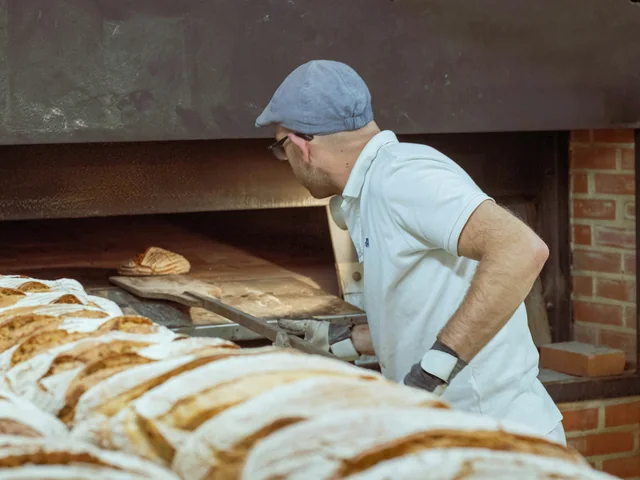
A server in an apron chatting with guests at laptops in a bright coffee shop.
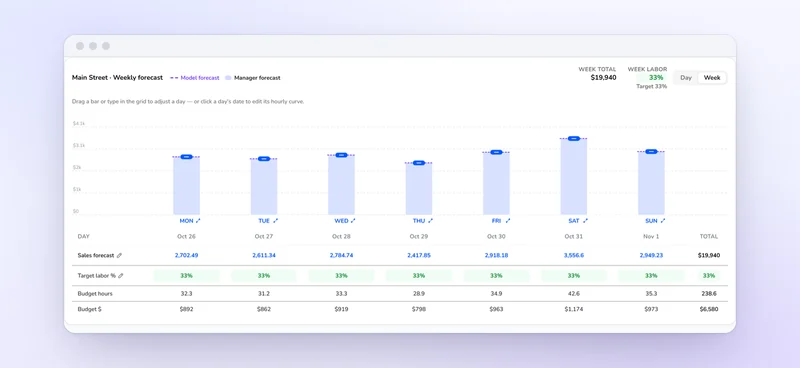
Kronto's weekly sales forecast: the week's total, the labor percent against its target, and each day's forecast bar.

How much does a coffee shop make?

Toast's model of a city coffee shop, a modeled example rather than a survey average, takes about $1,783 a day, $42,780 a month and $513,360 a year at full capacity. Real shops vary with size, hours, location and menu, so check yours: tickets per day times average ticket, times days open.

Toast's model shop opens 6:30 a.m. to 2 p.m., Monday through Saturday, and runs at 35% to 60% of that capacity in its first year⁠[1]. Its monthly figure counts four six-day weeks: $1,782.50 a day times 24 days is $42,780⁠[1]. The worked example below shows how to get the same figures from your own POS.

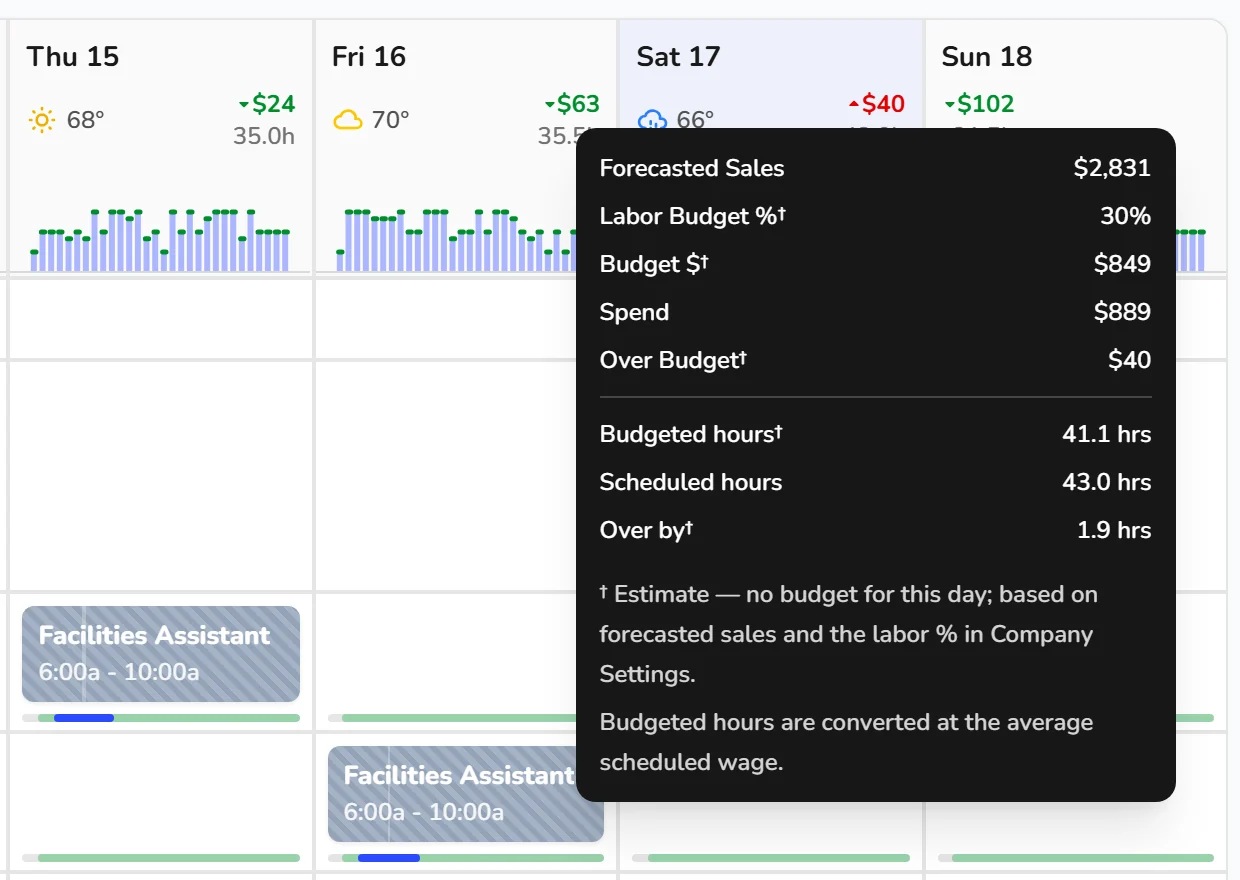
Kronto budget tooltip for a Saturday showing forecasted sales, the labor budget estimated from the company's labor percentage, scheduled spend, the amount over budget, and budgeted versus scheduled hours

Key takeaways

  1. Toast's model city coffee shop takes about $1,783 a day, $42,780 a month and $513,360 a year at full capacity.
  2. Find your own daily sales by multiplying tickets per day by your average ticket, half hour by half hour.
  3. Toast puts owners of small to medium-sized coffee shops at $60,000 to $160,000 a year.
  4. Labor is the cost you can change week to week, so a schedule that matches the morning rush moves owner pay.
  5. Estimate next month's revenue from each weekday's eight-week average times how many of that weekday the month has.
  6. A daily sales forecast sizes milk, bean and pastry orders, while item counts still come from your POS item report.

How much does an average coffee shop make a day?

Toast's model city shop, open 6:30 a.m. to 2 p.m., takes about $1,783 a day at full capacity and 35% to 60% of that in its first year. That is a model, not a measured average. Your own day is tickets times average ticket: pull both by hour from your POS. The worked example below shows the math.

How much do most coffee shop owners make?

Toast puts owners of small to medium-sized coffee shops at $60,000 to $160,000 a year. Where you land depends on what is left after cost of goods, labor, rent and card fees, and labor is the cost you can change week to week, so a schedule that matches the morning rush moves owner pay.

Owners of small to medium-sized coffee shops can make $60,000 to $160,000 a year, according to Toast⁠[1]. A shop that trims one barista from a slow afternoon, every weekday, keeps that wage as profit.

How do you estimate next month's coffee shop revenue?

Estimate next month's coffee shop revenue by averaging each weekday's sales over the last eight weeks, then multiplying by how many of that weekday the month has. A month with five Saturdays brings in more than one with four. Adjust for what you know is coming, like a school break, and check against actual sales weekly.

To see the same estimate built half hour by half hour, 8 weeks ahead, see sales forecasting in Kronto.

How does a sales forecast help with coffee shop inventory?

A daily sales forecast tells you how big each day will be, so milk, beans and pastry orders can follow it instead of habit. Scale standing orders to the forecast for the delivery window, and watch which days end with leftovers. Item-level counts still come from your POS item report.

A worked example: from one day to one year

The numbers below are an illustration for a small walk-up shop open seven days a week. Replace each line with your own POS figures.

Example: one weekday, by block of hours
HoursTickets an hourTicketsSales at $7 a ticket
7:00 to 10:0040120$840
10:00 to 2:001872$504
2:00 to 5:001133$231
Day225$1,575

Weekends rarely look like weekdays, so do the same for Saturday and Sunday. If this shop sold $1,575 on each of five weekdays and $1,900 on each weekend day, the week would be $11,675, about $50,600 a month and about $607,000 a year before any costs.

What labor really costs per hour of coverage

The median hourly wage for food and beverage serving and related workers was $15.24 in May 2025⁠[2]. In the example above, the afternoon brings in about $77 an hour, so one barista covers it comfortably and a second barista costs a fifth of what the hour brings in. In the morning the same person is a small fraction of $280 an hour. That is why the half-hour shape of the day matters more than the daily total.

Openers, closers and young staff

Coffee shops open early. Under federal child labor rules, 14- and 15-year-olds may work only between 7 a.m. and 7 p.m. (9 p.m. from June 1 through Labor Day), no more than 3 hours on a school day and 18 hours in a school week⁠[3]. Put adults on the opening shift, and use younger staff for after-school and weekend coverage.

Doing this in Kronto

Kronto reads each shop's sales history from Square, Toast or Clover and forecasts the next 8 weeks in half-hour, daily and weekly steps. A barista staffing ratio turns each half hour into required staff, and the schedule builder shows forecasted sales, the labor budget and scheduled cost for each day. Kronto does not track inventory or read holiday calendars, so a manager overrides a day's forecast by hand in the Budget workflow when needed. See sales forecasting in Kronto for how it works.

The half-hour forecast shapes coffee shop scheduling in Kronto, and the daily numbers feed the labor budget in Kronto.

Frequently asked questions

What is a good average ticket for a coffee shop?

It depends on your menu and whether food sells with the drink. Track yours weekly in the POS; a rising average ticket at the same ticket count is often the easiest growth.

Is a drive-through or a walk-up shop easier to forecast?

Both follow the same method. Forecast each one from its own history, because their peaks rarely line up.

Do I need software to forecast?

No. A spreadsheet works for one shop. Software saves the weekly export and averaging, and keeps each location separate.

How much does a coffee shop make a month?

Multiply a typical week by about 4.33. The example shop above sells $11,675 a week, about $50,600 a month. Toast's model shop sells $42,780 a month at full capacity⁠[1].

How much money can you make from a small coffee shop?

Toast's model shop, at full capacity, sells $42,780 a month against $38,800 of monthly operating costs, leaving about $3,980, a 9.3% margin⁠[1]. Lower rent or a tighter schedule changes that a lot, so run it with your own costs.

Sources

  1. How Much Do Coffee Shops Make? (2026 Data), Toast. Read October 23, 2026. ↩
  2. Food and Beverage Serving and Related Workers (Occupational Outlook Handbook), U.S. Bureau of Labor Statistics. Read October 23, 2026. ↩
  3. Fact Sheet #43: Child Labor Provisions of the FLSA for Nonagricultural Occupations, U.S. Department of Labor, Wage and Hour Division. Read October 23, 2026. ↩

Worked examples are illustrations, not benchmarks. Figures checked against the cited BLS and DOL pages on Oct 23, 2026. Last reviewed November 27, 2026.

Reviewed by Jonan Junwikul, Growth, Kronto, on November 27, 2026.

Know what the shop makes and what it pays out

Kronto puts your coffee shop's sales forecast next to scheduling, the time clock, tips and payroll, so the revenue you expect and the labor you pay for sit in one app.

Free for up to 10 people