Tip pool calculator: split tips by hours, points or equally
Split a tip pool to the cent by hours, points or equal shares, with managers left out automatically.
By Jonan Junwikul
Enter the tips and each person's hours, and the calculator splits the pool to the cent by hours, by points, or in equal shares with a minimum-hours rule. Managers and supervisors are left out automatically, because federal law bars them from tip pools. Everything you enter stays in your browser.
How does the tip pool calculator split tips?
It gives each eligible person their fraction of the pool by hours (or points × hours), rounds each share down to the cent, and hands out the leftover pennies one at a time to whoever has the least, so the shares always add up to the exact pool.
- Enter the total tips for the period you pool: a shift, a day, a week or a pay period.
- List everyone who worked and their hours. Hours count to the whole minute, so 4.17 hours counts as 4 hours 10 minutes.
- Pick a method: by hours, by points, or equal shares with a minimum number of hours.
- Each share = pool × (that person's hours ÷ everyone's hours). In a points pool, use points × hours in place of hours.
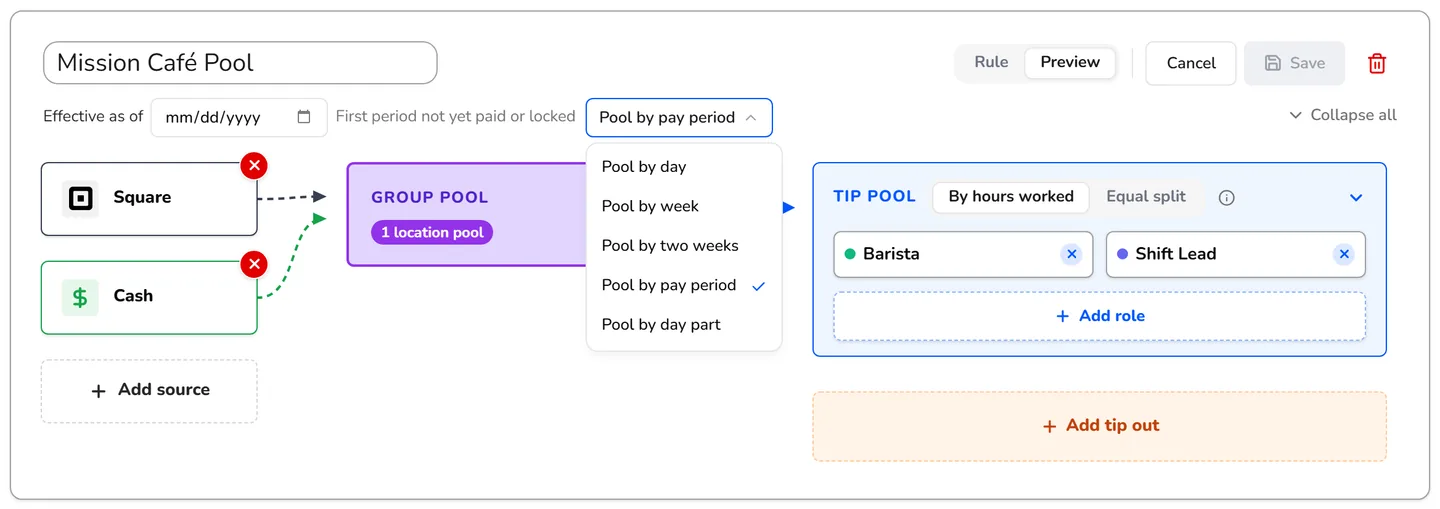
- Each share is rounded down to the cent. The leftover cents go one each to the lowest earner first, so the shares add up to the exact pool.
Anyone you mark as a manager or supervisor comes out of the pool before the math runs, and the results say why.
A quick example: a coffee shop pools $347.83 for one day across 30 hours 40 minutes. That's about $11.34 per hour worked, so a barista with 6.5 hours gets $73.72. The full example is in the worked examples below.
What's the difference between a tip pool and a tip-out?
In a tip pool, tips go into one pot and are split among everyone eligible. In a tip-out, each server or bartender keeps their own tips and gives a set share to support staff such as bussers, the bar or the host.
- Tip pool: common in coffee shops and counter service, where tips land in one jar or one card total. It splits by hours, points or equal shares.
- Tip-out: common in full-service restaurants, where each server's tips are tracked by check. It is usually a percent of the server's tips, sometimes a percent of their sales.
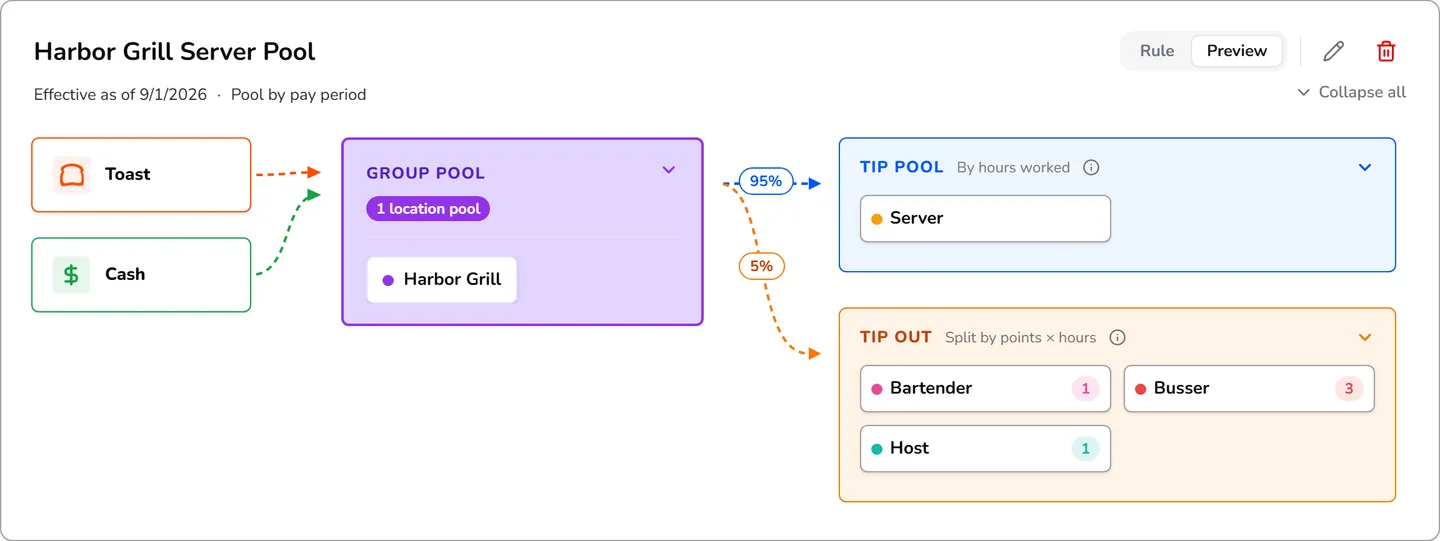
- Both: some restaurants pool servers' tips first, then tip out a percent of the pool to support roles. Kronto runs tip-outs this way, as a percent of pooled tips, and so does this calculator.
Federal law treats the money the same way in both: what a busser gets from a server counts as the busser's tips, and the same rules decide who may share.
To add a tip-out, click Add tip out under the split. Each person in the pool gives that percent of their share to the people in the roles you pick, and the results show what everyone gives, gets and keeps. The tip-out calculator page walks through the tip-out math step by step.
Which tip pooling method is fairest: hours, points or equal shares?
Splitting by hours is the most common and the easiest to explain: more time worked, a bigger share. Points let you weight roles differently, and equal shares are simplest when everyone works about the same shift.
| Method | How a share is figured | Works well when | Watch out for |
|---|---|---|---|
| By hours | Pool × your hours ÷ everyone's hours | Shift lengths vary and tips go into one jar for the day | A slow hour counts the same as the rush |
| By points | Pool × (your role's points × your hours) ÷ everyone's point-hours | Roles carry different work and you want to weight them, for example 12 points for a shift lead and 10 for a barista | Set the points before the period starts and put them in your written policy |
| Equal, with a minimum | Pool ÷ the number of people who worked at least the minimum hours | Everyone works a similar shift | Anyone under the minimum gets $0, so state the minimum in your policy |
| Tip-out | A set percent of each person's pool share goes to support roles, split by hours or by points × hours (equally when the pool splits equally) | Servers pool their tips and support staff such as bussers and the bar get a fixed share | A pool has one tip-out, at one percent. To give its roles different amounts, split it by points |
Same tips, three methods
Here is one coffee shop's day of $347.83 split three ways. The points column uses 10 points for baristas and 12 for shift leads. The equal column uses a 4-hour minimum.
| Person (hours) | By hours | By points (10 / 12) | Equal, 4-hour minimum |
|---|---|---|---|
| Maya, barista (6.5) | $73.72 | $68.47 | $86.96 |
| Luis, barista (5.25) | $59.55 | $55.31 | $86.96 |
| Jo, barista (4 h 10 m) | $47.26 | $43.90 | $86.96 |
| Ben, barista (3) | $34.03 | $31.61 | $0.00 (under 4 hours) |
| Rosa, shift lead (8) | $90.73 | $101.13 | $86.95 |
| Kai, shift lead (3.75) | $42.54 | $47.41 | $0.00 (under 4 hours) |
| Total | $347.83 | $347.83 | $347.83 |
In Kronto, you can pool by hours, by points, or equally with a minimum-hours threshold, and switch methods from an effective date you choose.
What does federal law say about tip pools?
Under the Fair Labor Standards Act (FLSA), an employer may never keep employees' tips, and managers and supervisors may never take a share of a tip pool. Who else may share depends on whether you take a tip credit.[1][2]
Managers, supervisors and owners are out
Section 3(m)(2)(B) of the FLSA says an employer may not keep employees' tips "for any purposes, including allowing managers or supervisors to keep any portion of employees' tips, regardless of whether or not the employer takes a tip credit."[2] An employer can't take a share of the pool either. A manager may keep a tip a customer hands them directly for service they alone provided.[1]
For this rule, a manager or supervisor is anyone whose duties match three parts of the DOL's executive test: their primary duty is managing the business or a department, they regularly direct the work of two or more employees, and they can hire or fire, or their recommendations on hiring, firing or promotion carry particular weight. The test looks at duties, not at salary, so an hourly shift lead who meets all three counts as a supervisor.[3][4]
If you take a tip credit: tipped staff only
A tip credit means you pay a tipped employee a cash wage below minimum wage and count their tips toward the rest. If you take one, a required pool may include only employees who customarily and regularly receive tips, such as servers, bartenders and bussers.[1]
- The federal cash wage is at least $2.13 an hour, and the tip credit is at most $5.12 an hour. Together they make the $7.25 federal minimum wage.[1]
- If tips don't make up the difference, you pay it.[1]
- Before you take the credit, you must tell tipped staff the cash wage, the tip credit amount, and that they keep their tips except for a valid pool.[1]
If you pay full minimum wage: back of house can join
If you pay tipped staff the full minimum wage in cash and take no tip credit, federal rules let you require a pool that includes cooks, dishwashers and other staff who aren't customarily tipped. Managers, supervisors and the employer still can't share. Your state may be stricter.[1]
Card fees, service charges and payday
- Card fees: you may take the card processing fee out of a card tip, but no more than the actual fee, and never so much that pay drops below minimum wage.[1] In California, the Labor Commissioner says employers can't deduct card fees from tips at all.[5] Check your state's labor department.
- Service charges: a mandatory charge, such as 18% added for a large party, is not a tip under federal law, even when you pay it out to staff. Keep it out of the tip pool.[1]
- Payday: if you collect and redistribute tips, pay them out no later than the regular payday for that workweek or pay period.[1]
- Contribution amount: if the pool is required, tell staff how much they must contribute.[1]
The 80/20 rule is no longer federal law
In 2021 the DOL limited the tip credit for side work to 20% of the workweek or 30 minutes in a row, often called the 80/20 rule. On October 29, 2024, the Fifth Circuit vacated those limits in Restaurant Law Center v. U.S. Department of Labor, and the DOL restored its older regulation effective December 17, 2024. That older rule still bars a tip credit for hours someone works in a separate, non-tipped job.[6]
General information, not legal or tax advice. Rules vary by state.
Which state laws change the tip pool math?
Seven states don't allow a tip credit at all: Alaska, California, Minnesota, Montana, Nevada, Oregon and Washington. There, every tipped employee gets the full state minimum wage before tips, so the federal tip-credit limits on who can share don't apply, but state law can set its own.[7]
- The list comes from the U.S. Department of Labor's table of tipped minimum wages, last revised July 1, 2026. The same table also lists Guam. Check your state's labor department for your current rates.[7]
- Oregon's minimum wage varies by region of the state.[7]
- California: the state's Labor Commissioner says tips can't count toward minimum wage, a pool can't pay owners, managers or supervisors, and the employer can't deduct card processing fees from tips.[5]
- Every other state allows some tip credit, each with its own cash wage. In many states the cash wage is above the federal $2.13.[7]
- Many states have their own tip and pooling rules. Check your state's labor department before you set up a pool.
The calculator doesn't apply state rules for you. It applies one federal rule: managers and supervisors are left out, with the reason in the results. It doesn't model a tip credit, so if you take one, leave back-of-house staff out of the pool yourself. It also flags card fees, which can't be more than the actual cost.
Does "No Tax on Tips" change how I run a tip pool?
No. "No Tax on Tips" is a federal income tax deduction that tipped workers claim on their own returns for 2025 through 2028.[8][9] Tips are still subject to Social Security and Medicare taxes, and your reporting duties as the employer still apply.[10]
What the deduction is
- It comes from Public Law 119-21, signed July 4, 2025, and covers tax years 2025 through 2028.[9]
- A worker can deduct up to $25,000 of qualified tips a year, whether or not they itemize.[8]
- The deduction drops by $100 for every $1,000 of modified adjusted gross income over $150,000, or $300,000 on a joint return.
- Qualified tips are voluntary cash or card tips from customers, including tips received through a tip pool. A mandatory service charge doesn't count unless the customer can change or skip it.[11]
- The job must be on Treasury's list of occupations that customarily received tips on or before December 31, 2024. The restaurant and café jobs on it include bartenders, wait staff, bussers and bar backs, hosts, cooks, food prep workers, dishwashers, bakers, and fast food and counter workers, which covers baristas.[11][12]
- Money a manager or supervisor takes from a tip pool is not a qualified tip. It isn't allowed under the FLSA either.
What it means for your pool and your reporting
- Keep each person's final tip amount, after pools and tip-outs, for every pay period. Payroll and year-end forms need it.
- W-2s must show cash tips and each worker's Treasury Tipped Occupation Code. The IRS gave employers transition relief for 2025 reporting in Notice 2025-62.[9][13]
- Social Security and Medicare still apply to tips of $20 or more a month, for both your share and the employee's.[10]
- Staff can file a new Form W-4 to account for the deduction, and you must use it.[10]
- The tax list doesn't change wage law. Cooks and dishwashers are on Treasury's list, but they still can't share a pool when you take a tip credit.
Ask a tax professional how the deduction applies to your business and your team.
How do I write a tip pool policy?
Put the rules in writing before the first shift they cover, and give a copy to everyone in the pool. A good policy says who is in the pool, how it splits, how often it pools and when people get paid.
- Who shares: list the roles. Leave out managers, supervisors and owners.
- Wage basis: say whether you take a tip credit. If you do, only customarily tipped roles can be in a required pool.
- Method: by hours, by points (list each role's points), or equal shares with a minimum number of hours.
- Pool period: per shift, day, week, pay period or day part. Morning and evening crews often pool separately.
- Tip sources: card tips, cash tips, and how cash is counted and recorded.
- Card fees: whether you deduct them, and that you never deduct more than the actual fee.
- Service charges: say they aren't tips and how they are paid.
- Payday: tips are paid no later than the regular payday for the period.
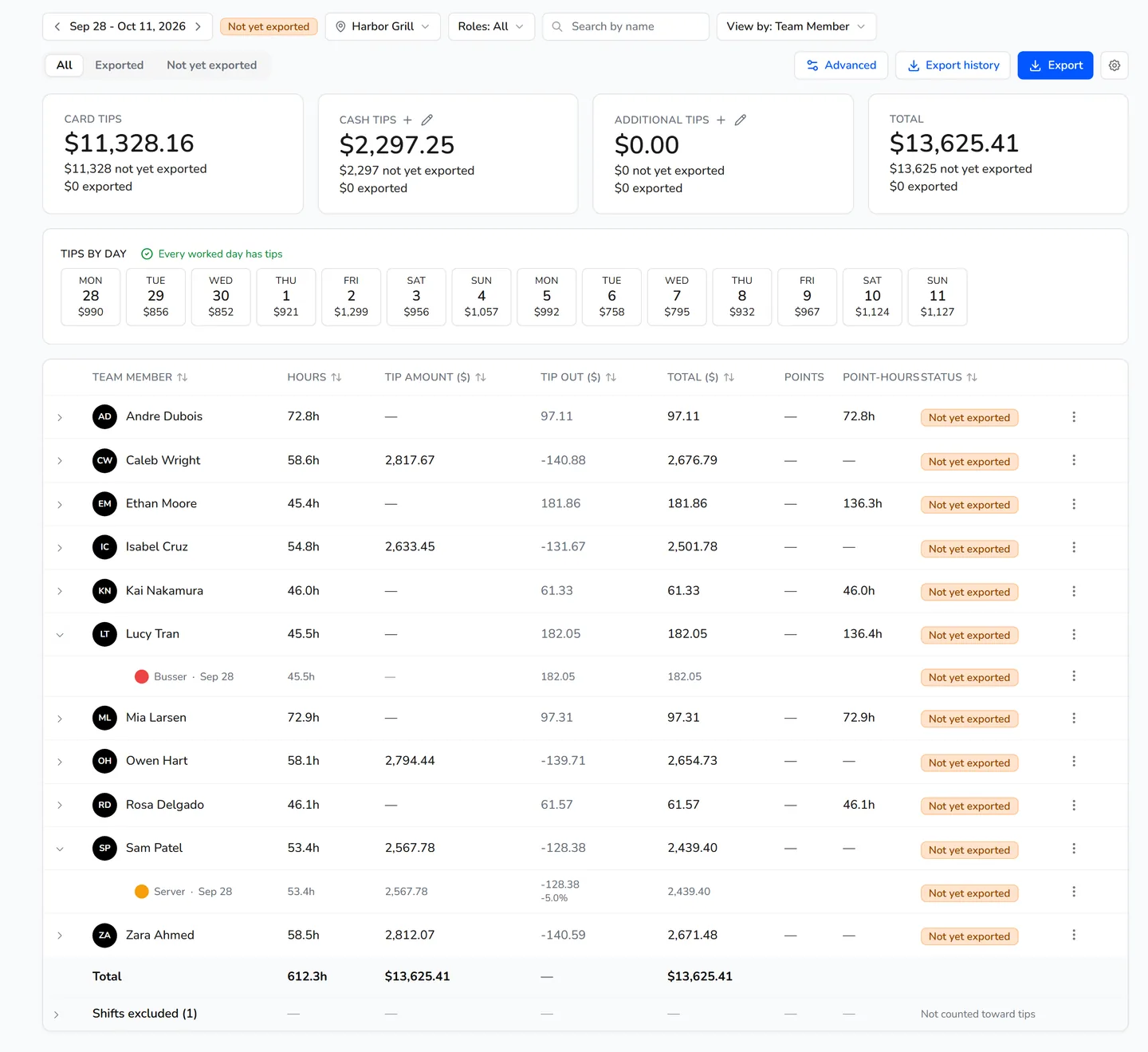
- Leftover pennies: who gets them. This calculator gives them to the lowest earner first.
- Changes: how you'll announce a change, and the date it takes effect.
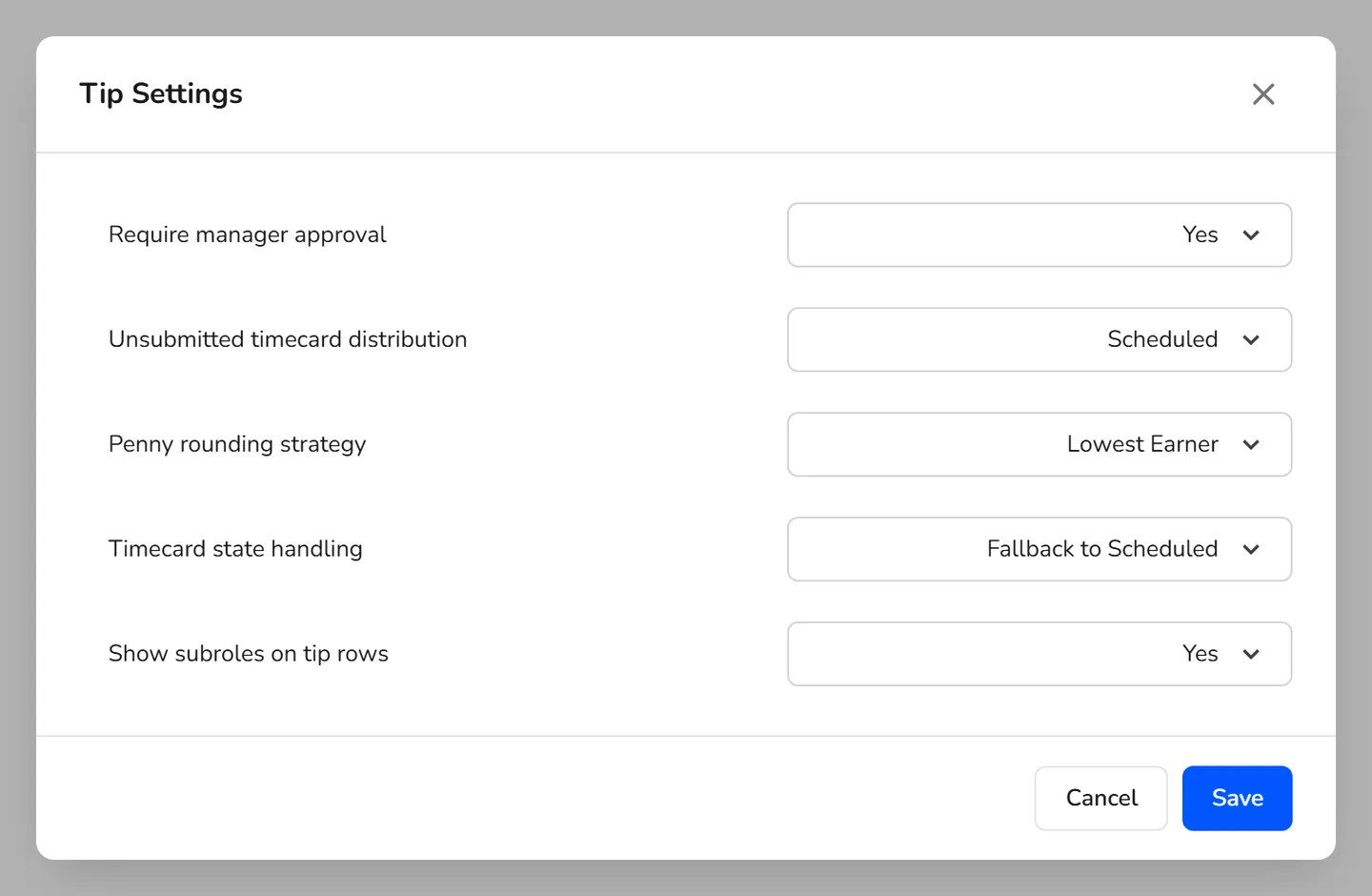
In Kronto, each tip rule starts on an effective date you choose, and team members see their own tip shares in the app. See how Kronto handles tips.
Tip pool examples for a coffee shop and a restaurant
Coffee shop: one day, pooled by hours
Four baristas and two shift leads share one day's tips of $347.83, split by hours. This is the calculator's Coffee shop preset. The shift leads are in the pool because, in this example, they don't meet the DOL's manager duties test.
| Person | Role | Hours | Share |
|---|---|---|---|
| Maya | Barista | 6.5 | $73.72 |
| Luis | Barista | 5.25 | $59.55 |
| Jo | Barista | 4.17 (4 h 10 m) | $47.26 |
| Ben | Barista | 3 | $34.03 |
| Rosa | Shift lead | 8 | $90.73 |
| Kai | Shift lead | 3.75 | $42.54 |
| Total | 30 h 40 m | $347.83 |
Each share is $347.83 × that person's hours ÷ 30.67 hours, rounded down to the cent, with any leftover cents going to the lowest earner first.
If a shift lead is really a supervisor
Say Rosa runs the store, directs the crew and makes the hiring calls. Then she is a supervisor and must come out of the pool. The same $347.83 splits across the other 22 hours 40 minutes: Maya $99.74, Luis $80.56, Jo $63.94, Ben $46.04 and Kai $57.55.
Restaurant dinner shift: servers pool, then tip out
Four servers pool $1,254.24 by hours: Dana (6.5 hours) $379.18, Eli (5) $291.69, Priya (6) $350.02 and Tom (4) $233.35. Each then tips out 3% of their share to the bussers and the bar, $37.62 in all, split by hours: Sam (5.5 hours) $12.73, Ava (4.75 hours) $11.00 and Noah, the bartender (6 hours), $13.89. The servers keep $367.81, $282.94, $339.52 and $226.35. The step-by-step math is on the tip-out calculator page.
Sources
- Fact Sheet #15: Tipped Employees Under the Fair Labor Standards Act (FLSA), U.S. Department of Labor, Wage and Hour Division. Read October 19, 2026. ↩
- 29 U.S.C. 203(m)(2): Fair Labor Standards Act definitions (tip credit and tip retention), U.S. Government Publishing Office (govinfo), United States Code 2023 edition. Read October 19, 2026. ↩
- 29 CFR part 531, subpart D: Tipped Employees (sections 531.52, 531.54, 531.55, 531.56, 531.59), Electronic Code of Federal Regulations (eCFR), Office of the Federal Register. Read October 19, 2026. ↩
- 29 CFR 541.100: General rule for executive employees, Electronic Code of Federal Regulations (eCFR), Office of the Federal Register. Read October 19, 2026. ↩
- Tips and gratuities (FAQ), California Labor Commissioner's Office (DLSE), Department of Industrial Relations. Read October 19, 2026. ↩
- Tip Regulations Under the Fair Labor Standards Act (FLSA); Restoration of Regulatory Language (89 FR 101884, Dec. 17, 2024), U.S. Department of Labor, Wage and Hour Division, via the Federal Register. Read October 19, 2026. ↩
- Minimum Wages for Tipped Employees (state table), U.S. Department of Labor, Wage and Hour Division. Read October 19, 2026. ↩
- What the "No Tax on Tips" deduction means for you, Internal Revenue Service. Read October 19, 2026. ↩
- Working Families Tax Cuts: Tax deductions for working Americans and seniors (FS-2025-03), Internal Revenue Service. Read October 19, 2026. ↩
- Publication 15 (2026), (Circular E), Employer's Tax Guide, Internal Revenue Service. Read October 19, 2026. ↩
- Treasury, IRS issue final regulations listing occupations where workers customarily and regularly receive tips (IR-2026-49), Internal Revenue Service. Read October 19, 2026. ↩
- Final regulations: Occupations That Customarily and Regularly Received Tips; Definition of Qualified Tips (26 CFR part 1, section 224), Federal Register April 13, 2026 (FR Doc. 2026-07104), Department of the Treasury, Internal Revenue Service, via the U.S. Government Publishing Office. Read October 19, 2026. ↩
- Treasury, IRS provide penalty relief for tax year 2025 for information reporting on tips and overtime under the One, Big, Beautiful Bill (IR-2025-110), Internal Revenue Service. Read October 21, 2026. ↩
General information, not legal or tax advice. Last reviewed October 21, 2026.
Frequently asked questions
How do you calculate a tip pool by hours?
Add up everyone's hours and divide the pool by that total to get a rate per hour, then multiply by each person's hours. For example, $347.83 over 30 hours 40 minutes is about $11.34 an hour, so 6.5 hours earns $73.72. Round each share down to the cent, then hand out the leftover pennies so the shares add up to the pool exactly.
Can managers or shift leads be in a tip pool?
Managers and supervisors can't take any share of a tip pool under federal law, whether or not you take a tip credit. A shift lead counts as a supervisor if managing is their main job, they regularly direct two or more employees, and they can hire or fire or their recommendations carry particular weight. Pay type doesn't matter. A shift lead who doesn't meet all three can share.[1][4]
Can cooks and dishwashers share in the tip pool?
Under federal law, only if you take no tip credit and pay your tipped staff the full minimum wage in cash. If you pay servers a tipped cash wage, the pool is limited to employees who customarily and regularly receive tips. Some states set stricter rules, so check with your state labor department before adding back-of-house staff.[1]
Is the 80/20 rule still in effect?
Not as federal law. On October 29, 2024, a federal appeals court vacated the DOL's 2021 side-work limits of 20% of the workweek or 30 minutes in a row, and the DOL restored its older rule in December 2024. You still can't take a tip credit for hours worked in a separate, non-tipped job. State rules may differ.[6]
Can I take credit card fees out of employees' tips?
Under federal law you may deduct the card processing fee on a card tip, but no more than the actual fee, and never so much that pay falls below minimum wage.[1] In California, the Labor Commissioner says the full card tip must go to the employee, with no fee taken out.[5] Check your state's labor department before you deduct.
Does No Tax on Tips change how I split tips?
No. It is a federal income tax deduction of up to $25,000 a year that tipped workers claim for 2025 through 2028, and it includes tips received through a tip pool.[9] Social Security and Medicare still apply, and W-2s must now show each worker's tipped occupation code. Ask a tax professional how it applies to you.
Who gets the leftover pennies when a pool doesn't divide evenly?
The calculator rounds every share down to the cent and gives the leftover cents one at a time to the lowest earner first. If two people tie, the one listed first gets the cent.
Is what I enter saved or sent anywhere?
Nothing you enter is sent to a server. The calculator runs in your browser and saves a draft there so you can pick up where you left off. If you copy a share link, the names and amounts are part of the link, so anyone you send it to can see them.
Does it cost anything to use the calculator?
No. The calculator has no sign-up and no limit on how many pools you split. You can download the results as a CSV, print them, copy them into Google Sheets or share a link. If you want Kronto to run your tip pools every pay period from real time cards, you can book a demo.
Scheduling, time clock, tips and payroll in one place
Kronto is built for restaurants and cafes. Build the schedule, clock your team in on a tablet or phone, split tips from the hours they worked and run payroll, all in one app.
Book a DemoBook a demo to get 2 months free
Get Started
Book Demo
Tell us a little about your business, then pick a time for your demo.
Book a demo to get 2 months free