

Who's covered: chains of 30 or more
A fast food establishment is part of a chain, mainly serves food and drinks, offers limited service, and is one of 30 or more such establishments nationally. Customers order and pay before they eat, take their food to go, or order delivery[4].
Its fast food employees are the people working there who clean, cook, serve customers, deliver, prepare food or drinks, do routine maintenance, provide security or stock supplies. That includes workers placed by a contractor or temp firm. Salaried workers who are exempt from overtime under New York State law are not covered[4].
This guide covers fast food employers only, as the city's FAQ does[4]. It does not cover the law's rules for retail employers.
Every worker gets a regular schedule in writing
Each fast food employee needs a written regular schedule, on paper or electronically. It shows the hours they can expect each week, the expected days, times and locations, and the date it takes effect[4]. Their baseline regular schedule is the one with the most total hours in the previous 12 months[4].
A week's work schedule can differ from the regular schedule. If the difference in weekly scheduled hours is more than 15% over the whole week, the employer has to get the employee's written consent before posting that week[4].
14 days' notice, counted to the hour
Each work schedule has to reach employees at least 14 days before the workweek starts. The city counts 14 days as at least 336 hours before the first day on the schedule, which begins at 12:00 a.m.[4][2]. The schedule covers seven days and lists the date, location, start time and end time of each shift[4].
Employers post the schedule where workers will see it and also give it to each worker in writing, electronically if that is how they usually reach workers. When the schedule changes, the employer updates it within 24 hours of learning about the change, or as soon as possible, and gives the update to everyone affected[4].
Late changes cost $10 to $75 each
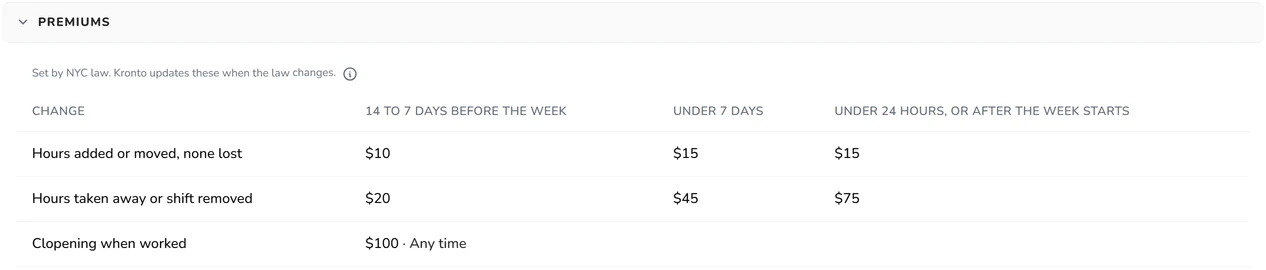
A change the employer makes with less than 14 days' notice owes the employee a premium for each change. Notice is counted from when the employee is told about the change to the first day on the work schedule[4]. These are the amounts the city sets[4]:
| Notice given | Hours added | No change in total hours | Hours cut |
|---|---|---|---|
| Less than 14 days | $10 | $10 | $20 |
| Less than 7 days | $15 | $15 | $45 |
| Less than 24 hours | $15 | $15 | $75 |
The employee agreeing to a change does not waive the premium[4]. The law has four exceptions[4]:
- The store can't operate because of threats, a utility or public transit failure, a fire, flood or other natural disaster, a declared state of emergency, or severe weather that threatens employees' safety[4].
- The employee asked for or started the change, such as asking for time off, calling out, using safe and sick leave, arriving late or leaving early for a personal need, and the employer keeps written records showing it[4].
- Employees trade shifts with each other voluntarily[4].
- Time added to the schedule is paid at the overtime rate[4].
Some changes look like requests but are not. A premium is still owed when a manager asks someone to come in early or work an extra shift, and when an employee works past the end of a shift. It's also owed when an employee volunteers after the employer or its scheduling app asks for volunteers, and when an employee picks up an open shift the employer posted in a scheduling app[4].
Added hours also need the employee's consent: workers can say no to extra hours before they are added[4]. The premiums paid and their amounts go on the employee's wage stub for that pay period, noted separately[4].
Clopenings take written consent and $100 each time
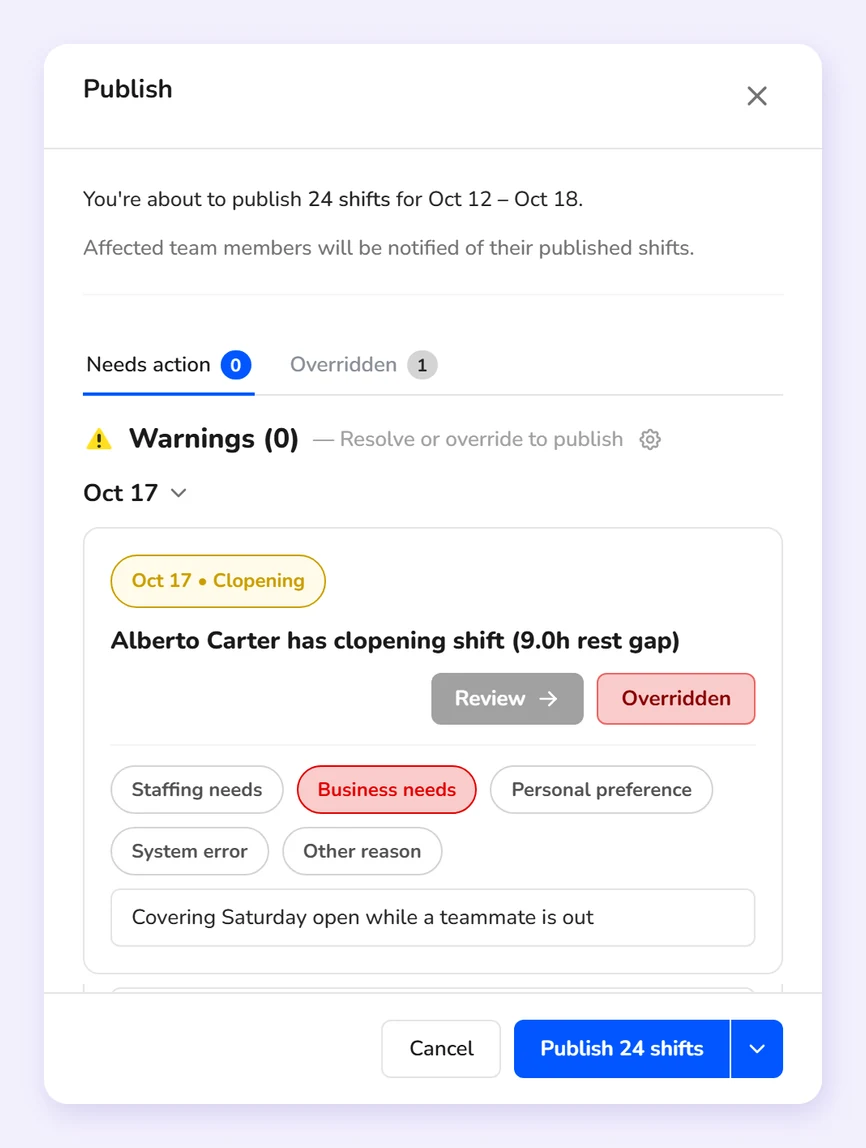
A clopening is two shifts over two days with less than 11 hours between them, where the first shift ends the day before or spans two days. An employer can schedule one only when the employee has a chance to decline, consents in writing, and is paid a $100 premium for each clopening worked[4].
When someone stays late and that leaves less than 11 hours before their next shift, the employer has to offer to start the next shift later. The late stay owes $15 for time added with less than 7 days' notice. The next shift adds more:
- Keeping its original start needs written consent and owes $100.
- A later start that cuts hours owes $75.
- Moving the whole shift later owes $15.
Telling the employee not to clock in until 11 hours have passed does not avoid the $100[4].
New hours go to your current team first
Before hiring someone new, the employer has to tell current workers who worked at least 8 hours in the past 30 days about available shifts at any of its locations. It posts a notice for three consecutive days where workers will see it and sends the information electronically, such as by text or email[4]. This applies when the employer is hiring or expects to hire[4].
Firing or cutting hours needs a reason the law accepts
After an employee's first 30 days, an employer may fire them only for just cause or for a bona fide economic reason, with the least senior employees laid off first. Cutting an employee's hours by more than 15% from their baseline regular schedule or a work schedule is treated the same way, unless the employee asked for or agreed to the cut[4]. A discharged employee gets a written notice of discharge within five days[4].
Keep every version for three years
Employers keep records showing they followed each part of the law for three years and give them to DCWP when asked. Missing records can create a presumption against the employer[4]. The rules list the records required at 6 RCNY §7-603[4][2].
Records can be kept in a scheduling app if they stay in their original format for three years, can be exported to a non-proprietary, machine-readable format, and are never overwritten. For example, the app must keep the original version of a work schedule and the date it was given to employees[4].
Employers also post the notice NYC FAST FOOD WORKERS' RIGHTS where employees can easily see it at each NYC workplace, in English and in any language that is the primary language of at least 5% of the workers there, when DCWP offers it[4][3].
A weekly routine that follows the rules
- Keep a written regular schedule on file for everyone, and update it before a lasting change.
- Build the week from regular schedules, and get written consent before posting any week that moves someone's hours more than 15%.
- Post and send the week at least 14 days before it starts, counted to 12:00 a.m. on its first day.
- Before changing a sent week, check the notice left, the premium it owes and whether an exception applies. Get written consent for added hours.
- Check every close followed by an open for the 11-hour gap, and get written consent first.
- Put each premium on the wage stub as its own line, and keep every version of the schedule for three years.
General information, not legal advice. For questions about the law, DCWP can be reached at OLPS@dcwp.nyc.gov or through 311[4].
Let the schedule keep the 14-day clock
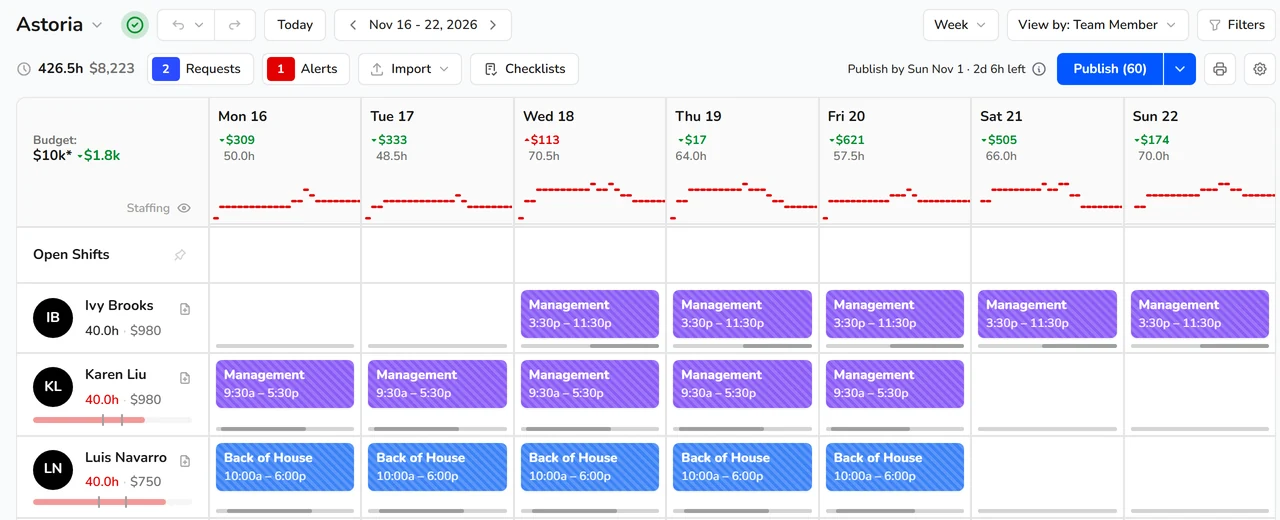
For NYC fast food locations, Kronto's NYC Fair Workweek counts down to the 14-day deadline beside Publish. It shows the premium for a change before the change is saved, collects your team's written yes or no on their phones, and keeps the record by location, person and day.
 Jonan Junwikul