Tip-out calculator: how much servers tip out
Work out what each server tips out to bussers, the bar and the host, and what every server keeps.
By Jonan Junwikul
Enter the servers' tips and hours and a tip-out percent for the support roles, and see what every server gives and keeps and what each busser, bartender and host takes home. The servers' tips are pooled first and split by hours, by points or equally; then the tip-out comes out of every server's share, the way Kronto runs tip-outs. Nothing you enter leaves your browser.
What is a tip out?
A tip out is the share of their tips that servers pay to the support staff who helped earn them, such as bussers, bartenders and hosts. It is usually a set percent of tips or of sales, paid at the end of a shift. Managers, supervisors and owners can never receive any of it.
Tip out or tip pool: which one fits my restaurant?
Use a tip-out when servers keep their own tips and pay support staff a fixed share. Use a tip pool when tips come in as one pot, like a coffee shop's jar or a shared card total.
- Tip-out: each server keeps their own tips, minus a percent for each support role. A busier server pays more in dollars and also keeps more.
- Tip pool: everyone eligible shares the whole pot, usually by hours. The tip pool calculator page covers the ways to split one.
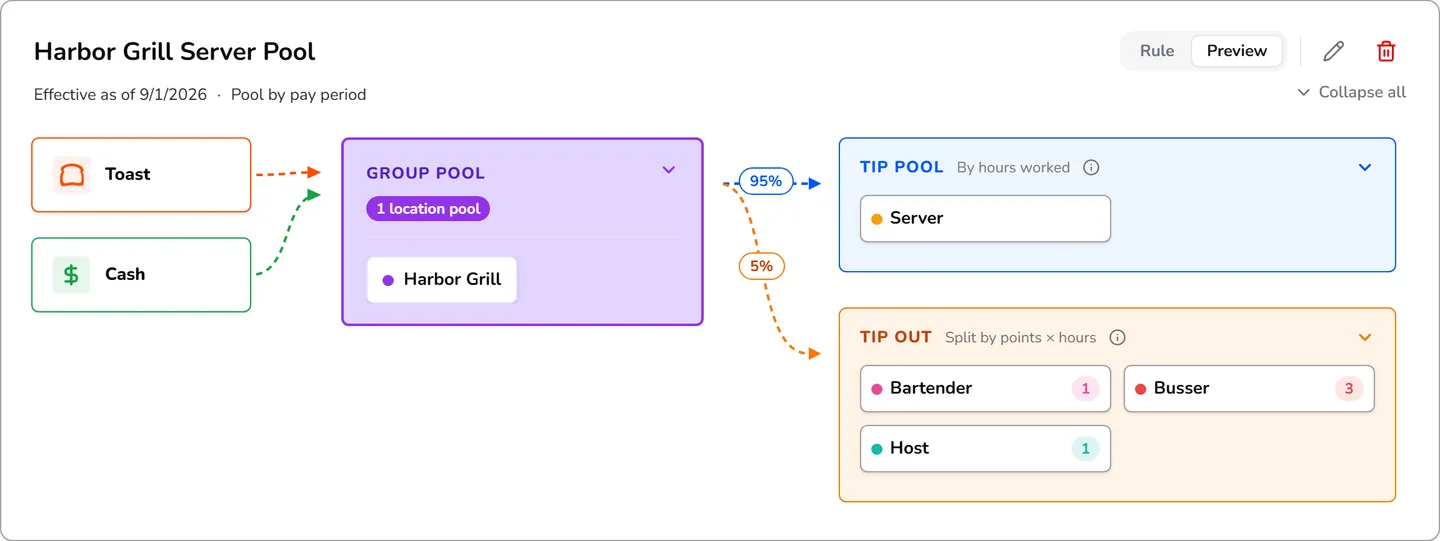
- Both: pool the servers' tips first, then tip out a percent of the pool to support roles. That is how Kronto runs tip-outs, as a percent of pooled tips, and it is how this calculator figures them.
If each server keeps their own tips, enter one server at a time as the pool, with their tips and hours, to see that server's tip-out.
Under federal law, what a busser gets from a server is the busser's tip, and the same rules on who may share apply as in a pool.
How does the tip-out calculator work?
It works the way Kronto runs tip-outs: the servers' tips are pooled and split first, then each server gives a set percent of their share to the support roles. The calculator rounds each server's tip-out down to the cent, puts every server's tip-out into one pot, and splits that pot among the people in the receiving roles.
- Enter the servers' tips for the shift and each server's hours. The pool splits by hours, by points or in equal shares.
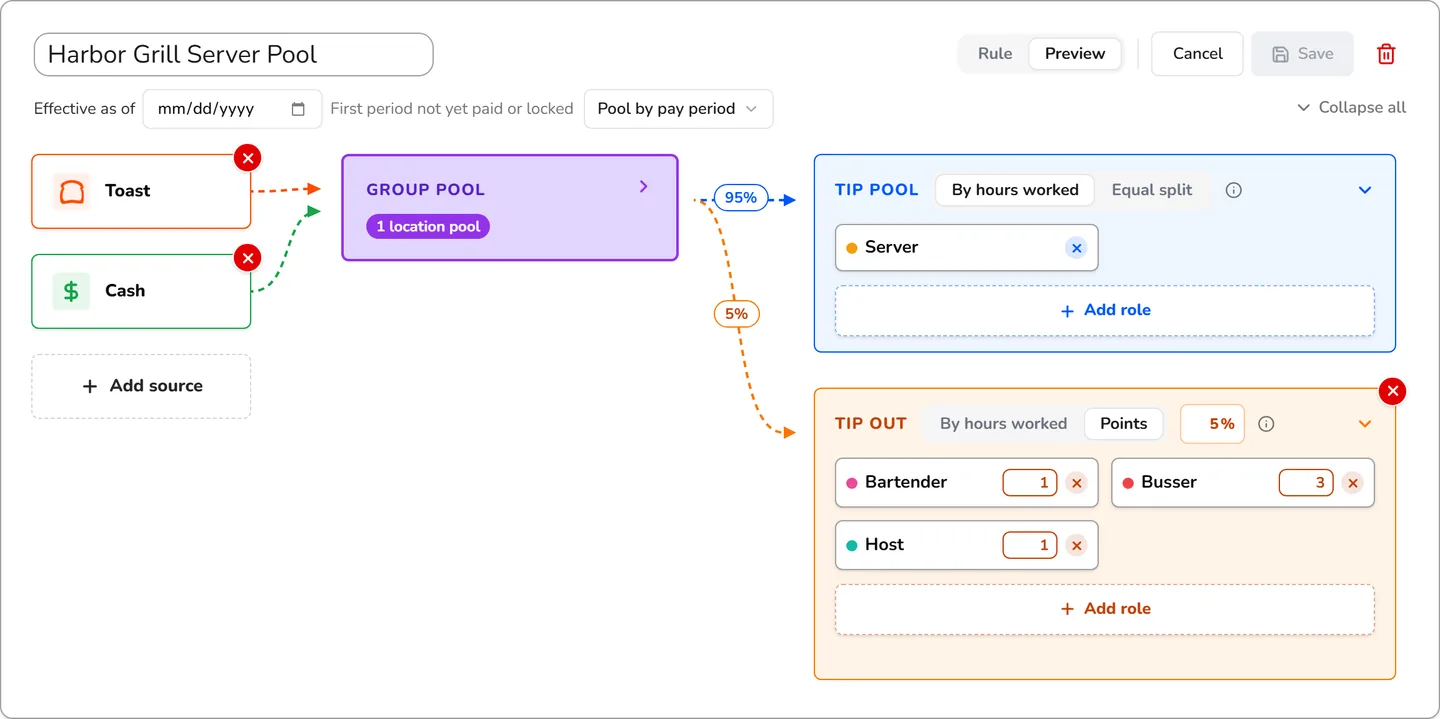
- Set the tip-out percent and its receiving roles, such as 3% to the bussers and the bar. The calculator starts with 3% to the bussers already added. A pool has one tip-out, as in Kronto, so to tip out the bar or the host too, add them as receiving roles of that tip-out.
- The tip-out is a percent of each server's share of the pool, so no server gives more than their share.
- Each server's tip-out is rounded down to the cent. The fraction of a cent stays with the server.
- The pot is split among the people in the receiving roles by hours, or by each role's points × hours. When the pool splits equally, the tip-out does too. Leftover cents go to the lowest earner first.
- If nobody in a tip-out's roles can get a share, for example nobody has hours, nobody is charged for it. The calculator doesn't model a tip credit, so if you take one, don't add a Back of house role to a tip-out.
Example: a server whose share of the pool is $379.18 tips out 3% to the bussers and the bar. $379.18 × 0.03 = $11.3754, so the server gives $11.37.
Should a tip-out be a percent of tips or a percent of sales?
A percent of tips moves with what the server actually earned, so a server can never owe more than they made. A percent of sales ties the tip-out to how much the server sold, which on a night of low tips can cost the server more than their tips.
| Option | How it's figured | Works well when | Watch out for |
|---|---|---|---|
| Tip-out, % of tips | Server's share of the tips × percent | You want the tip-out to rise and fall with what servers earn | Depends on accurate cash tip records |
| Tip-out, % of net sales | Server's net sales × percent | Your house already sets tip-outs on sales and tracks sales per server | It can be more than the server's tips. This calculator figures tip-outs on tips, not sales |
| Receivers split by hours | Tip-out pot × your hours ÷ every receiver's hours | Bussers or bar backs work different shift lengths | Needs accurate hours for each receiver |
| Receivers split by points | Tip-out pot × (your role's points × your hours) ÷ every receiver's point-hours | Receiving roles carry different work, such as bussers and the bar | Set the points in your written policy |
| Receivers split equally | Tip-out pot ÷ the receivers who worked at least the pool's minimum hours | The pool itself is split in equal shares | Anyone under the minimum gets $0 |
There is no federal standard percent, and federal rules set no maximum on how much employees can be required to contribute. The example's 3% is an example, not a recommendation.
This calculator figures tip-outs as a percent of tips, the way Kronto runs them: a percent of each person's share of the pooled tips.
Are tip-outs legal, and who can receive them?
Yes. Federal law lets you require servers to tip out other employees, as long as no manager, supervisor or owner gets any of it. If you take a tip credit, tip-outs can go only to staff who customarily and regularly receive tips, such as bussers and bartenders.[1]
- Managers and supervisors: never, whether or not you take a tip credit. An hourly shift lead counts as a supervisor if they meet the DOL's duties test.[1][2]
- Kitchen staff: cooks and dishwashers can receive a tip-out only if you take no tip credit and pay tipped staff the full minimum wage in cash.[1]
- Tip credit: under federal law the cash wage is at least $2.13 an hour and the credit at most $5.12.[1]
- Card fees: you may take out no more than the actual processing fee on a card tip.[1]
- Side work: the 2021 "80/20" limits were vacated by a federal appeals court in 2024 and are not federal law.[3]
The full federal rundown, including the manager duties test and the 2024 court ruling, is on the tip pool calculator page.
General information, not legal or tax advice. Rules vary by state.
Do state laws limit tip-outs?
Some do. In the seven states with no tip credit (Alaska, California, Minnesota, Montana, Nevada, Oregon and Washington), servers earn the full state minimum wage before tips, so the federal tip-credit limit on who can receive doesn't apply, but state law can set its own.[4]
- California's Labor Commissioner says a tip pool can't pay owners, managers or supervisors, and card processing fees can't be taken out of tips.[5]
- Federal rules don't cap the tip-out percent. Check your state for any limit before you set one.
- Many states have their own tip-sharing rules. Check your state's labor department.
The state list and its source are on the tip pool calculator page.
How do tip-outs work with "No Tax on Tips"?
Tips a busser, bartender or host gets through a tip-out count as qualified tips for the federal deduction, as long as their job is on Treasury's list.[6] The deduction is something each worker claims for 2025 through 2028.[7] It doesn't change Social Security and Medicare taxes, or how you split tips.
- Bussers and bar backs, bartenders, hosts and wait staff are all on Treasury's list.[8]
- The deduction is up to $25,000 a year and shrinks above $150,000 of modified adjusted gross income ($300,000 for joint filers).[9]
- W-2s must show cash tips and each worker's tipped occupation code, with transition relief for 2025.[7][10]
- A mandatory service charge isn't a qualified tip unless the customer can change or skip it.[6]
- Keep each person's tips after tip-outs, what each server kept and what each receiver got, for every pay period. Ask your tax professional how to report them.
More detail is on the tip pool calculator page. Ask a tax professional how the deduction applies to your team.
What goes in a tip-out policy?
Write down who tips out, to whom, how much and on what basis, and give it to every server before it starts. If staff are required to tip out, the policy is also how you tell them the amount.
- Who tips out: the roles that give, such as servers and bartenders.
- Who receives: each receiving role. No managers, supervisors or owners.
- How much: the percent for each receiving role, and whether it is figured on tips or on net sales.
- Low-tip nights: if you tip out on sales, what happens when a tip-out would be more than the server's tips.
- How each role splits its share: by hours, by points or equally, with any minimum hours.
- When it's figured: per shift, per day or per pay period.
- Tip credit: whether you take one. If you do, only customarily tipped roles can receive.
- Card fees: whether you deduct them, never more than the actual fee.
- Payday: tip-outs are paid no later than the regular payday for the period.
- The start date, and how you'll announce a change.
In Kronto, a tip-out takes a set percent of the pooled tips and splits it among support roles by points and hours worked, from an effective date you choose. See how Kronto handles tips.
Tip-out example: a restaurant dinner shift
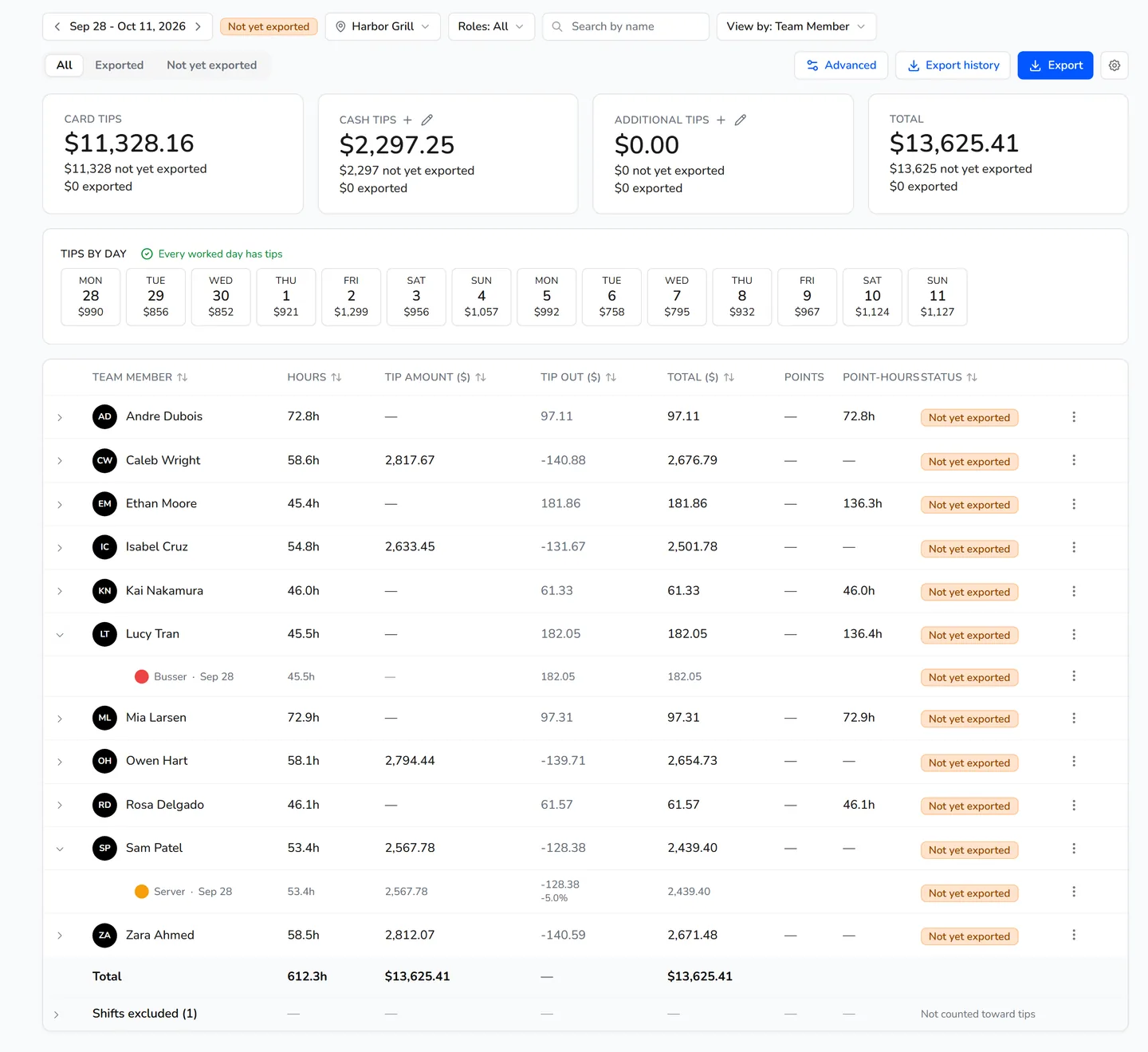
Four servers pool $1,254.24 in tips by hours, then each tips out 3% of their share to the bussers and the bar, split by hours. This is the calculator's Restaurant dinner shift example.
| Server | Hours | Pool share | Tip-out (3%) | Keeps |
|---|---|---|---|---|
| Dana | 6.5 | $379.18 | $11.37 | $367.81 |
| Eli | 5 | $291.69 | $8.75 | $282.94 |
| Priya | 6 | $350.02 | $10.50 | $339.52 |
| Tom | 4 | $233.35 | $7.00 | $226.35 |
| Total | 21.5 | $1,254.24 | $37.62 | $1,216.62 |
How the bussers and the bar split $37.62
Sam and Ava, the bussers, worked 5.5 and 4.75 hours, and Noah, the bartender, worked 6, so 16.25 hours in all. Sam gets $37.62 × 5.5 ÷ 16.25 = $12.73 and Noah gets $37.62 × 6 ÷ 16.25 = $13.89. Ava's $37.62 × 4.75 ÷ 16.25 rounds down to $10.99, and the one cent left over goes to the lowest earner, so she gets $11.00.
If your house tips out on sales
Some restaurants set tip-outs on net sales instead. Say the bussers get 1% of net sales and the servers sold $2,200, $1,650, $1,900 and $1,100: the bussers' pot would be $68.50 however much the servers made in tips. This calculator doesn't figure tip-outs on sales. It takes them from tips, the way Kronto does.
When a sales tip-out is more than the tips
A server who sold $1,850 but made $48.00 in tips owes $55.50 at 3% of sales, $7.50 more than they made. A tip-out on tips, as this calculator figures it, can't do that. If you tip out on sales, decide in your policy what happens on a night like that, and check your state's labor department before asking anyone to cover a tip-out from their wages.
For a coffee shop that pools one jar by hours, see the worked example on the tip pool calculator page.
Sources
- Fact Sheet #15: Tipped Employees Under the Fair Labor Standards Act (FLSA), U.S. Department of Labor, Wage and Hour Division. Read October 19, 2026. ↩
- 29 CFR 541.100: General rule for executive employees, Electronic Code of Federal Regulations (eCFR), Office of the Federal Register. Read October 19, 2026. ↩
- Tip Regulations Under the Fair Labor Standards Act (FLSA); Restoration of Regulatory Language (89 FR 101884, Dec. 17, 2024), U.S. Department of Labor, Wage and Hour Division, via the Federal Register. Read October 19, 2026. ↩
- Minimum Wages for Tipped Employees (state table), U.S. Department of Labor, Wage and Hour Division. Read October 19, 2026. ↩
- Tips and gratuities (FAQ), California Labor Commissioner's Office (DLSE), Department of Industrial Relations. Read October 19, 2026. ↩
- Treasury, IRS issue final regulations listing occupations where workers customarily and regularly receive tips (IR-2026-49), Internal Revenue Service. Read October 19, 2026. ↩
- Working Families Tax Cuts: Tax deductions for working Americans and seniors (FS-2025-03), Internal Revenue Service. Read October 19, 2026. ↩
- Final regulations: Occupations That Customarily and Regularly Received Tips; Definition of Qualified Tips (26 CFR part 1, section 224), Federal Register April 13, 2026 (FR Doc. 2026-07104), Department of the Treasury, Internal Revenue Service, via the U.S. Government Publishing Office. Read October 19, 2026. ↩
- What the "No Tax on Tips" deduction means for you, Internal Revenue Service. Read October 19, 2026. ↩
- Treasury, IRS provide penalty relief for tax year 2025 for information reporting on tips and overtime under the One, Big, Beautiful Bill (IR-2025-110), Internal Revenue Service. Read October 21, 2026. ↩
- 29 U.S.C. 203(m)(2): Fair Labor Standards Act definitions (tip credit and tip retention), U.S. Government Publishing Office (govinfo), United States Code 2023 edition. Read October 19, 2026.
- 29 CFR part 531, subpart D: Tipped Employees (sections 531.52, 531.54, 531.55, 531.56, 531.59), Electronic Code of Federal Regulations (eCFR), Office of the Federal Register. Read October 19, 2026.
- Publication 15 (2026), (Circular E), Employer's Tax Guide, Internal Revenue Service. Read October 19, 2026.
General information, not legal or tax advice. Last reviewed October 21, 2026.
Frequently asked questions
What is a tip out?
A tip out is the share of their tips that a server pays to the support staff who helped earn them, such as bussers, bartenders and hosts. It is usually a set percent of tips or of sales, and managers and owners cannot receive any of it. This calculator figures each server's tip out as a percent of tips, the way Kronto does.
How do you calculate a server's tip-out?
Multiply the server's tips by the tip-out percent, and round down to the cent. In this calculator, as in Kronto, that is the server's share of the pooled tips: a server whose share is $379.18 and who tips out 3% gives $11.37. Add every server's tip-out into one pot, and split the pot among the people in the receiving roles by hours, or by points × hours.
Should tip-outs be based on tips or on sales?
A percent of tips means a server never owes more than they earned. A percent of sales ties the tip-out to what the server sold, so it is steady for support staff but can cost a server more than their tips on a slow night. Whichever you pick, put it in your written tip policy. Kronto runs tip-outs as a percent of pooled tips, and this calculator figures them the same way.
Who can receive a tip-out?
Under federal law, any employee except managers, supervisors and owners, if you pay full minimum wage and take no tip credit. If you take a tip credit, only employees who customarily and regularly receive tips, such as bussers and bartenders, can receive a required tip-out. State rules can be stricter, so check yours.[1]
Can a manager or shift lead get a tip-out?
No manager or supervisor can receive any part of a required tip-out or pool, whether or not you take a tip credit. A shift lead counts as a supervisor if managing is their main job, they regularly direct two or more employees, and they can hire or fire or their recommendations carry particular weight. Pay type doesn't matter.[1][2]
Can servers tip out the kitchen?
Under federal law, yes, but only if you pay tipped staff the full minimum wage in cash and take no tip credit. If you pay servers a tipped cash wage, cooks and dishwashers can't receive a required tip-out. Your state may have its own rules, so check before adding back-of-house staff.[1]
What if a tip-out is more than the server made in tips?
That can happen only when the tip-out is a percent of sales. A server who sold $1,850 but made $48 in tips would owe $55.50 at 3% of sales. This calculator figures tip-outs as a percent of tips, so a server always keeps the rest of their share. If you tip out on sales, decide in your policy what happens on those nights, and check your state's rules before taking any shortfall from wages.
Do tip-outs count for No Tax on Tips?
Yes. Tips received through a tip-sharing arrangement count as qualified tips for the federal deduction, if the worker's job is on Treasury's list. Bussers, bartenders, hosts and wait staff are on it. Workers claim up to $25,000 a year for 2025 through 2028. Ask a tax professional how it applies to your team.[6]
Can Kronto handle tip-outs automatically?
Yes. In Kronto, contributing roles give a set percent of their pooled tips to support roles, who split it by points and hours worked. Card tip data comes from Square, Toast and Clover, and cash tips are declared on the store tablet with a PIN. At the end of the pay period you export hours and tips as a payroll-ready CSV.
Scheduling, time clock, tips and payroll in one place
Kronto is built for restaurants and cafes. Build the schedule, clock your team in on a tablet or phone, split tips from the hours they worked and run payroll, all in one app.
Book a DemoBook a demo to get 2 months free
Get Started
Book Demo
Tell us a little about your business, then pick a time for your demo.
Book a demo to get 2 months free